Putting Yourself Out There
What it felt like to present my own research at NiDS
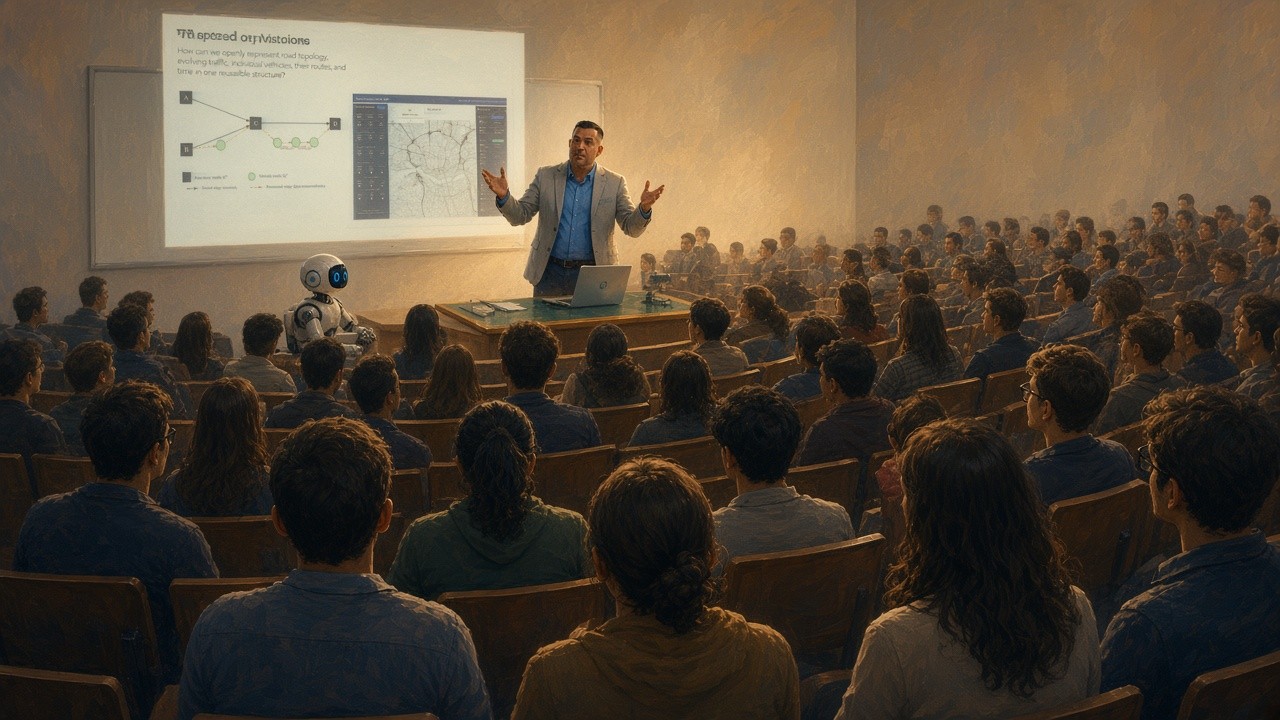
This was not the first time I gave a short speech in front of many people.
It was the first time I presented something that was my own research.
That difference changed everything. I had spoken before. I knew the feeling of a room, a microphone, and a clock. What I had not known was the feeling of standing behind two years of my own questions — work that had been private, stubborn, and often frustrating — and saying, in public: this is what I found.
It was exciting. It was even fun.
Two years, then a room
The paper I presented at NiDS 2026 is about route-aware dynamic traffic graphs for estimated time of arrival: how to represent road topology, vehicles, routes, and time in one reusable structure, and how to connect that representation to controlled, repeatable model testing.
Those are details. I have lived inside them for a long time.
The road to meaningful results was bumpy. There were months when the simulation would not behave, the graphs would not line up with the labels, or the evaluation story felt incomplete. There were moments when I wondered whether anyone would care about a toolchain that tries to make ETA research a little more reproducible. Research of this kind can look small from the outside. It talks about representations, validation, and workflows. It does not announce a revolution.
And yet I made it to a place where I can say that the work contributes something to the research community.
That is meaningful.
When I finally stood in the lecture room, with the slide about representation on one side and validation on the other, I was not only explaining a method. I was closing a loop that had been open for two years. The work had left my desk. It was in the room with other people.
More than meets the eye
One might think: who cares about this research that only talks about some details?
I understand the question. I have asked it myself, late at night, when the details felt endless.
But there is more than meets the eye in participating in a convention, giving a lecture, and socializing. You are not only delivering results. You are making contact. You meet researchers who took photographs of your talk, asked about your graphs, and later became people you can write to. You hear how others framed a similar problem. You put a face to a paper, and a paper to a person.
You have yourself out there.
That part is easy to underestimate if you only count citations. A convention is also a social act. It is a decision to be findable.
A Brazilian email, and forgotten Portuguese
A few years ago I posted a video of my work connecting MuJoCo and Unity for robotics simulation. At the time, MuJoCo had limited documentation, and many people — including me — struggled with its API. I shared the video because I was proud that I had made something work. I did not imagine it would travel.
A few months later I received an email from a researcher in Brazil. He had found the video and asked if I could help him with MuJoCo.
I was astonished. Someone I had never met, in another country, had found a small piece of my work and thought it might help. I was thrilled to help. I even got the chance to surprise him by communicating in my forgotten Portuguese.
That exchange stayed with me. It was not fame. It was a reminder that when you leave a trace, someone may pick it up.
The point is that it puts you out there.
Why this site exists
That is also why I maintain this site.
I have a feeling that someday it will serve others who are exploring similar topics, or who are simply curious enough to learn from my humble experience. A research notebook. A paper. A clumsy first version of a tool. A blog post about a lecture. None of these need a large audience to be worth keeping. They need to be reachable.
NiDS gave me that feeling again. Presenting my own research made the work feel more real — not because it was finished or immune to criticism, but because it had entered a conversation. That is a vulnerable thing to do. It is also part of the point.
I came home grateful: for the chance to speak, for the researcher who took the photographs, for the people I met in the corridors, and for the strange path that took a frustrating two-year effort and turned it into something I could stand behind in public.
The road was bumpy.
But it was done.
And I was there, with myself out there, saying so.